Friday, October 12, 2012

Photography!

An art career that I've always been interested in is photography. Photography is suited to my personality because I love looking at things and seeing the beauty in them, especially when it comes to nature because it's God'd creation. To become a professional photographer, official education isn't always required. It is; however, recommended to obtain a degree from a photography school or art school.
For professional photographers, the average yearly income is between 30,000 and 40,000, although income can still vary greatly from one photographer to the next.
There are many specialized fields in photography. Glamor photographers specialize in taking pictures of models, still life photographers specialize in taking pictures of still objects (such as scenery), and some photographers specialize in taking portrait pictures. Other areas of photography are underwater photography, wedding photography, and science photography. If I became of photograher, I would want to be a nature photographer. The start up expenses vary a lot from each different field of photography, ranging from 2,000 to 10,000 in most cases.
The portfolio that a photographer would need would contain examples of that photographer's best work. Some photographers have more than one portfololio, each one showing a different type of photography.


Friday, September 28, 2012

Response to historical artwork


This painting is called the “School of Athens.” It was painted by Raphael in 1510. It is one of four frescoes painted in the Vatican Palace in Rome. Each of the four frescoes are dedicated to a different branch of knowledge, with the “School of Athens” being dedicated to philosophy. 

Raphael’s use of texture makes this painting seem really realistic. The stone painted in this picture actually looks like stone. Raphael uses a variety of line, which is visually pleasing throughout the painting. His perspective is awesome because the back of the painting looks way further away than the front of the picture. I really like this painting because of how realistic it looks. I also really like it because of the history behind it.

Friday, September 21, 2012

Response to Contemporary Artwork


This elephant was painted by Thierry Bisch, a French artist. 
Bisch's use of value and color give depth and realism to the painting. His color choice is neutral, which along with his up-close use of space and the focus on the eye gives the painting a serious feeling.
His use of lines and value give the elephant good texture.
I like this painting because of how realistic it is. I especially like the differing value throughout the painting.

Thursday, September 13, 2012

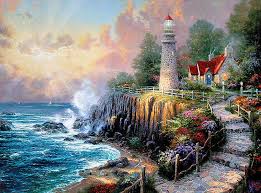
 Thomas Kinkade
Thomas Kinkade was born in 1958 and grew up in the Sierra Mountains in Placerville, California. By the age  of four, his calling as an artist was evident. He was known as “The Painter of Light.” He was nicknamed this because he wanted to share the “light” of Christ with his viewers. He was a devout Christian, and his goal as an artist was to touch the lives of people and to bring peace and joy into their lives through his artwork. His dearest wish had always been that his art would bring a message of hope to others, and that it would encourage them to look for the beauty in the world around us.
This is also one of my goals as an artist. I want to express myself and my love for God and others through my artwork. I also want to be able to portray our union with Christ and each other and the security that it brings. 

Thomas Kinkade put an emphasis on the glow and warmth of light. His paintings radiated light, either from a welcoming home or from the sun filtering through the clouds. His emphasis on light created a feeling of security and peace and an overall visually pleasing piece of art.
To create these feelings he relied on three visual aspects: Soft edges, warm colors, and an overall sense of light.
His use of space gives an open and free-spirited feeling. His paintings were never chaotic or frightening because of how he used colors and space.
His motivation for painting was to paint straight from the heart. His love for God, nature, and family can clearly be seen in many of his paintings.